Project planning
How many rubber mats do I need? A practical measuring guide
Room area gives you a starting quantity, not a finished order. A reliable rubber mat estimate also considers the layout, actual coverage of each tile, perimeter cuts and any replacement stock you want to keep.
Measure the usable floor and label your units
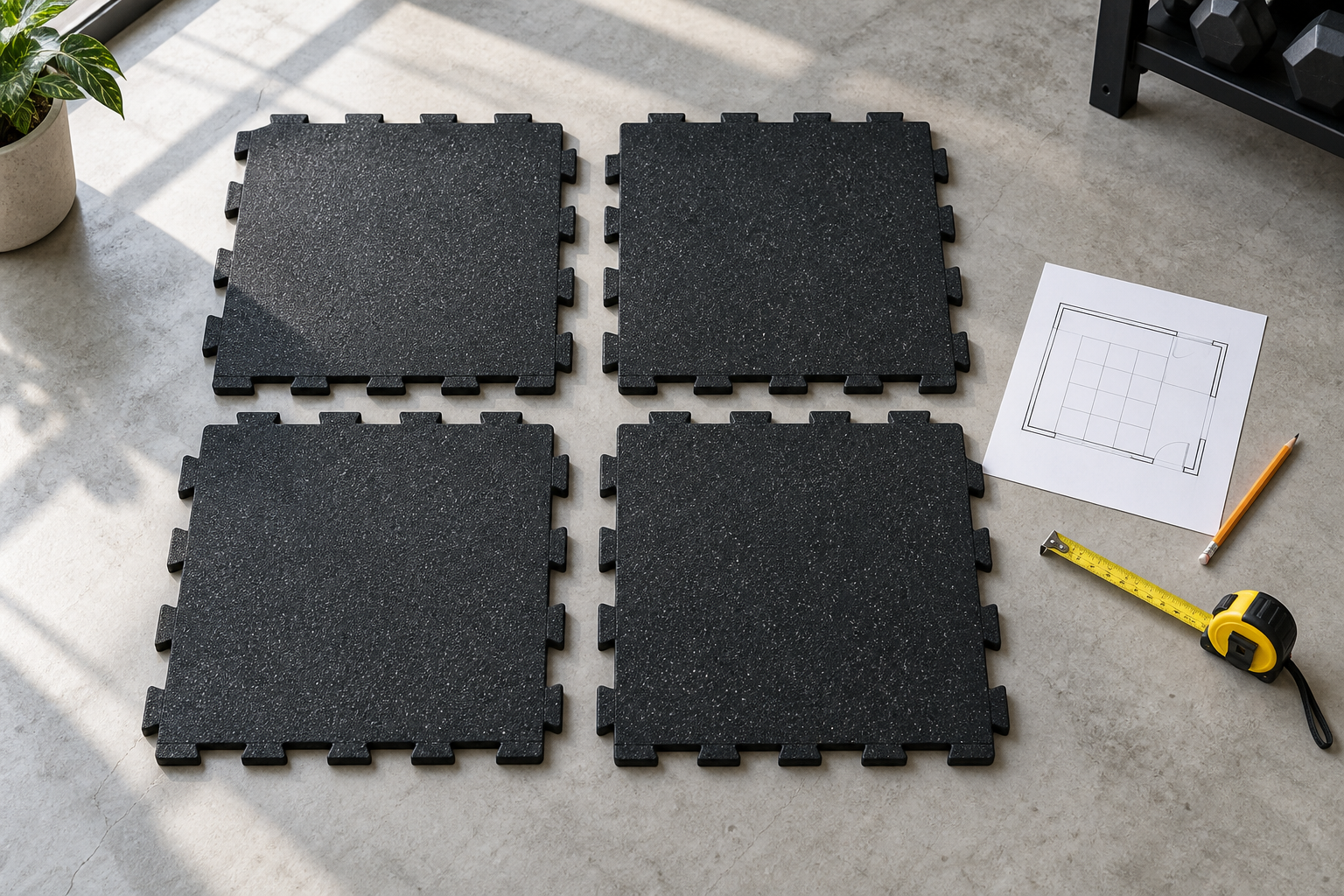
For a rectangular room, multiply length by width in metres to obtain square metres. Divide an irregular room into smaller rectangles, calculate each area and add them together. Mark columns, recesses and fixed equipment on a sketch rather than trying to explain the shape in a message.
Keep units consistent. One square metre is approximately 10.764 square feet. Do not multiply a dimension in feet by another in metres. Check the narrowest and widest points where walls are not parallel, and record doorway widths separately for the finishing detail.
Use nominal coverage for an initial calculation
A nominal 500 x 500mm square covers 0.25m2, equivalent to four squares per square metre. A nominal 1000 x 1000mm square covers 1m2. Divide the room area by the coverage to get an initial tile count and round up to a whole tile.
For example, a 5m by 4m room is 20m2. The nominal starting quantity is 80 tiles at 500 x 500mm, or 20 tiles at 1000 x 1000mm. This arithmetic excludes cutting waste, pack quantities and spare stock. It is not an order recommendation for a specific product.
Check actual coverage for interlock mats
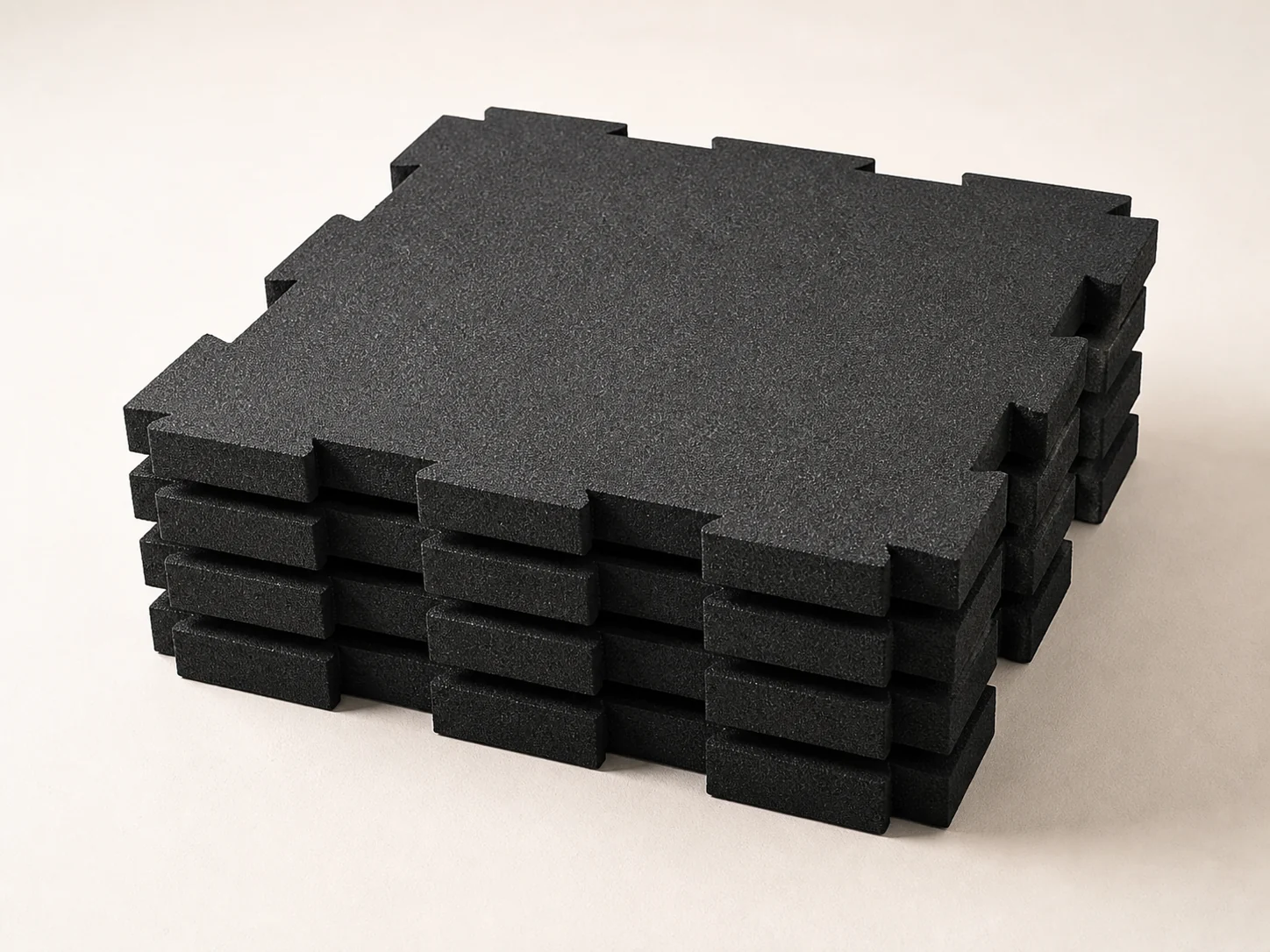
With interlock mats, confirm whether the stated dimensions describe the overall piece or its installed coverage. Connecting profiles and border pieces can affect the calculation. Ask for the working dimensions before drawing the final layout.
A useful layout shows complete rows and columns, the width of the last cut row and how the starting position changes the edges. An area-only calculation cannot tell you whether the remaining offcuts will fit elsewhere. Keep coloured patterns and tile orientation in the plan if applicable.
Agree cutting allowance and spare stock separately
There is no single waste percentage that suits every room. A simple rectangle, a diagonal pattern and a space with many columns will produce different cuts. Ask the installer to explain the allowance based on the layout, then distinguish that from unopened replacement tiles kept after the job.
Confirm pack quantities and delivery weight before ordering. For heavy-duty rubber mats, available size and thickness combinations must also be checked. A quantity calculation does not establish which thickness is appropriate for the equipment or supporting floor.
Turn the estimate into a quotation
- Dimensioned sketch with doorways, columns and fixed objects.
- Net measured area and the measurement units.
- Proposed mat format, thickness and approved coverage.
- Layout-based cutting allowance and separate replacement stock.
- Site postcode, floor level and delivery access.
Send the sketch to ACCT Global with your preferred mat type. Use our rubber flooring quotation checklist to compare supply, installation and finishing on the same basis.